
Betfair Premium Charge and High-Stakes Exchange Liquidity 2026
 Available in US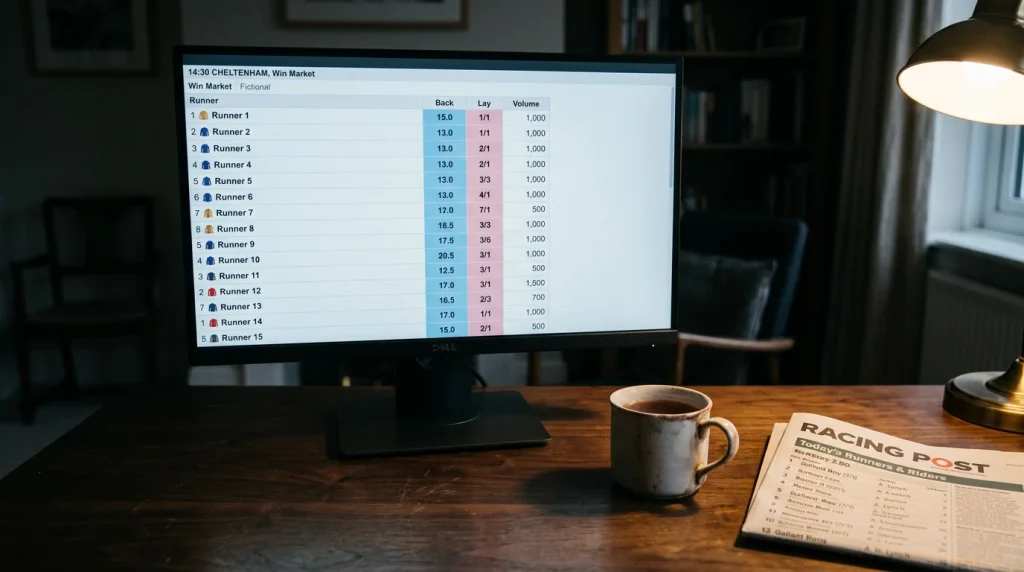
High-Stakes Betting Commission: Minimising Betfair Exchange Fees
It was a quiet Tuesday in February three years ago. I’d had a strong twelve months on Betfair — nothing exotic, just steady value-finding on jumps handicaps, banked at a level I was quietly proud of. I sat down with a spreadsheet, a coffee, and the year’s settled bets, and I worked out something that should have been obvious months earlier. After commission and the additional charge that had been quietly applied to my account, my realised return was roughly 62% of the gross profit shown on my P&L screen. The other 38% had gone, in instalments, to Flutter.
That was the moment I stopped thinking of Betfair commission as a 5% rounding error and started treating it as a structural cost line that needed managing. The Premium Charge — the additional levy Betfair applies to its most consistently profitable customers — is the single largest commercial variable separating the exchange’s marketing message from the experience of the punters who actually generate its winning P&L. And while the standard commission is much-discussed, the Premium Charge sits behind a wall of conditional language and one-on-one customer service that means most punters either don’t know it applies to them until it does, or have heard of it but underestimate by half how much of their return it captures.
What follows is what I wish someone had handed me three years ago. The mechanics of how the exchange actually works for large stakes, what standard commission and the Premium Charge are and where they diverge, who triggers the charge and what the trigger looks like in practice, how liquidity differs between Premier and Core fixtures, where Smarkets and Matchbook fit as alternatives, a worked example on a £20,000 lay, and what all of this means tactically when you are placing five- and six-figure bets on UK racing.
When calculating your overall profitability, it is crucial to compare exchange liquidity versus fixed-odds bookmakers to ensure your stakes are matched efficiently.
How an exchange actually clears a five-figure bet
Most articles on betting exchanges start with definitions. I’d rather start with what happens when you click. Imagine you want to lay £20,000 on the favourite at 3.5 in a Saturday handicap, fifteen minutes before the off. The bet doesn’t enter a single market — it enters the matched book against existing back orders. If there’s a back order at 3.5 already sitting for £8,000, the first £8,000 of your lay is matched instantly. If the next back order is at 3.4 for £12,000, the remaining £12,000 of your lay matches against the 3.4 price, not the 3.5 you typed. You have just paid slippage on more than half your stake, because the book wasn’t deep enough at your price.
This is the first thing about exchanges that catches new large-stake punters out. Bookmakers offer fixed prices on quoted stakes; exchanges offer the best matched price across whatever liquidity is available. On a thin market, that distinction can move your effective price by a tick or two and quietly knock 3-4% off your edge before commission is even calculated. Betfair Exchange processed something around £84 billion in matched stakes in 2025, which is an enormous number until you remember that most of it is concentrated in a small number of races and time windows. The midweek 1pm card from Plumpton is not where that £84bn lives.
The second thing to internalise is that on the exchange, you are betting against other customers, not against a house. Your back order needs a lay order on the other side, at the same price, with at least the same matched size. The exchange takes a commission from the winning side of each settled bet. The marketing message has always been that this commission is uniform and transparent. The reality, for the kind of punter generating consistent winning P&L, is that the headline 5% commission is the start of a much longer cost story.
Standard commission versus the Premium Charge
The standard commission on Betfair Exchange is 5% of net winnings per market in the UK and Ireland. That is the number on the website. It applies to your winnings on each settled market and is deducted at settlement. If you win £1,000 net on a market, you pay £50, and £950 lands in your account. Smarkets quotes its standard commission at 2%. Matchbook quotes 2% as standard, with promotional periods at 0% on selected products. So far, so simple.
The Premium Charge is the second commission layer that applies to a small subset of Betfair customers and which can take the effective cost of using the exchange from 5% to 20%, 40%, or — in the highest tier and on the most consistently profitable accounts — close to 60% of net winnings over a rolling lifetime calculation. The mechanism is rolling and cumulative. Betfair compares the total commission you have paid since the inception of your account against the total profit your account has generated. If the ratio of commission paid to profit generated drops below certain thresholds, the additional Premium Charge is applied to bring it back into the bracket Betfair considers appropriate.
Three things make this materially harder to model than a flat commission. First, the charge is calculated lifetime-rolling, not weekly or monthly, so a strong year can pull a winning account into Premium territory even after a slower stretch. Second, the calculation includes all sports and all markets, not just horse racing — a punter who is breaking even on football and crushing horse racing pays Premium Charge based on combined activity, which is rarely intuitive. Third, the brackets and the percentages are publicly documented but the precise calibration of each customer’s status is private to Betfair, and the customer service answer to “where am I in the brackets” is typically vague enough that most punters only know they’re in a higher bracket when the deduction shows up.
For the deeper comparative picture across the smaller exchanges that don’t operate this kind of layered charge, the structural side of how Smarkets and Matchbook compare to Betfair covers the commission and liquidity trade-offs in detail.
Who actually triggers the charge
The Premium Charge does not apply to losing accounts. It does not apply to recreational accounts. It does not even apply to most winning accounts, depending on which year of betting you’re in. The triggers are mathematical and unforgiving, and the cleanest way to think about them is in terms of three thresholds.
Threshold one. Your account has been open for at least 60 weeks. This is the qualification rule. The Premium Charge does not start until you have a sufficiently long history for the lifetime ratio to be meaningful.
Threshold two. Your lifetime commission paid is less than 20% of your gross lifetime profit on the exchange. This is the central mechanic. If you have generated £100,000 of net profit and paid only £15,000 of commission across that profit, you sit below the 20% line and the Premium Charge will start topping up the deduction to keep the ratio at 20%. The 20% line, in practice, captures any punter whose strike rate is consistently positive and whose winning markets dominate their losing markets in net P&L terms. Most successful value bettors land in this category eventually.
Threshold three. Your account has generated more than £250 in gross profit across at least 250 settled markets. This is the materiality cut-off. Tiny accounts don’t trigger.
The higher tier — what punters informally call the “Super Premium” — kicks in for the most profitable accounts, where the commission-to-profit ratio is materially lower than 20% and the account is generating very large absolute profits. At this tier, the additional charge ratchets up to 40% of weekly profits over thresholds, and the lifetime cap on what counts as commission paid is recalculated more aggressively. This is the tier where punters report effective commission rates in the high thirties and forties on top of the standard 5%.
Alex King, a professional gambler who has been forthright about the realities of the job, captured the texture of operating in this environment when he said that he wouldn’t recommend professional punting to too many people, unless you have a real flair and/or a huge desire to do it — that you have to be able to evaluate a price better than the people setting the odds, and you must also have a solid staking plan in place. He’s not talking about Premium Charge directly, but the implication is exactly the same. The professional toolkit assumes the charge exists; the staking plan is built around the post-charge return, not the gross return.
Liquidity by meeting type and time of day
The Premium Charge is one cost. Slippage from thin liquidity is the other, and on certain meetings it is the larger one. The William Hill data on Cheltenham 2025 — all 28 races at the Festival landed in the top 31 most-bet UK races of the year — tells you everything about where exchange liquidity also concentrates. Premier Fixtures attract the back orders. Core Fixtures attract them in fractions.
The shape of liquidity through a race day follows a predictable curve at any meeting. From morning prices opening, matched volume builds slowly. Around two hours before the off, the market starts to firm up as overnight prices give way to traders setting positions for the day. The bulk of matched volume on the back-lay book lands in the final fifteen to twenty minutes before the off, when the screen at home is more or less the screen the on-course traders are looking at. In-running volumes can be enormous on flagship races and trivial on midweek handicaps.
For a five-figure stake on a Premier Fixture in the last fifteen minutes, slippage is usually inside one or two ticks. For a five-figure stake on a Core Fixture at the same time, slippage can easily be five to ten ticks — which, on a 4.0 price, is the difference between landing your bet and walking away with a materially worse effective price than you intended. The practical rule I use, on midweek handicaps, is to either split the stake across two or three orders placed over the final five minutes, or to accept that the bet I want to place is too big for the market and to either move to a fixed-odds operator (if I have an account that will take it) or shrink the stake.
One more wrinkle on exchange liquidity that doesn’t get talked about enough. The £84 billion 2025 turnover figure is for the whole exchange business, not for UK racing. UK racing’s share is a substantial but minority slice of that, and within UK racing, jump racing accounts for more matched volume than flat racing in absolute terms, despite flat racing’s larger fixture count. If you trade primarily flat fixtures, your effective liquidity environment is thinner than the headline numbers suggest.
Smarkets and Matchbook as alternatives
The temptation, once you’ve worked out what the Premium Charge is costing you, is to move your business in its entirety to one of the alternative exchanges. That instinct is partly right and partly wrong, and the trade-offs deserve clear-eyed treatment.
Smarkets quotes a flat 2% commission with no Premium Charge layer. Matchbook quotes the same 2% standard rate, with periodic 0% promotional periods on selected racing products. On paper, both alternatives massively undercut Betfair for any punter in the Premium Charge brackets. In practice, the trade-off is liquidity. On Cheltenham Tuesday, the Smarkets win market on the Champion Hurdle will have meaningful depth — enough to absorb four- and low-five-figure bets without serious slippage. On a Wednesday afternoon handicap at Wolverhampton, the same market on Smarkets may have a couple of hundred pounds matched at the top of the book, against tens of thousands on Betfair.
What this means for stake distribution is straightforward and, once you’ve internalised it, painless. For Premier Fixtures, where liquidity is sufficient on the smaller exchanges to absorb your stakes inside acceptable slippage, the case for routing through Smarkets or Matchbook is compelling. The 3-percentage-point commission saving over Betfair standard (5% vs 2%) is real, and the absence of the Premium Charge multiplier above that is the bigger prize. For Core Fixtures, where the smaller exchanges’ books are too thin, you have a genuine dilemma — pay the slippage on the smaller book, or pay the Premium Charge on Betfair, and the right answer depends on which is the bigger drag in your specific situation.
The arbitrage between exchanges is also a non-trivial source of edge for the punter who is set up to chase it. Prices on the same horse can differ by a tick or two between Betfair and Smarkets at the same moment, particularly in the run-up to the off when liquidity is moving fastest. For a high-stake punter, the discipline of always checking the second screen before clicking is one of the more boring and more valuable habits you can build.
For more comprehensive strategies on managing large bankrolls, return to our main guide on high-stakes horse racing betting.
A worked example: the £20,000 lay
Let me put numbers to the abstractions. Say you decide to lay £20,000 on a horse at 3.5 in a Saturday handicap. You expect the horse to lose. Your edge calculation suggests the fair price is more like 4.0 — a meaningful but not enormous edge. Walk through the cost stack with me.
At a back price of 3.5, your liability is £50,000 (the £20,000 stake at 2.5 net odds the layer would owe if the horse wins). If the horse loses, you keep the £20,000 in stake. On Betfair at standard commission, you pay 5% of that, so £1,000 in commission. Net profit on the bet: £19,000. So far so good.
Now overlay the Premium Charge. Suppose you sit in the 20% bracket, meaning lifetime commission paid is below 20% of lifetime profit. The Premium Charge mechanism will top up the deduction so the ratio returns to 20%. The exact additional charge depends on your account history, but for a strong winning account, a £19,000 winning market like this will typically see an additional Premium Charge applied at settlement equal to a meaningful fraction of the standard commission — often in the range of an additional 15% on top, so a further £2,850, taking total deduction to £3,850 and net retained profit to £16,150. A high-bracket Super Premium account would see the deduction climb materially further, potentially into £7-8,000 of total cost on the £20,000 stake.
The same lay on Smarkets at 2% commission and no Premium layer: £400 deduction, £19,600 net. The headline saving over a Betfair standard-bracket trade is £600 (3% of stake). The saving over a Betfair Premium-bracket trade is £3,450 (over 17% of stake). On a single bet, the difference between routing decisions can be larger than the entire margin most professional punters are operating on.
The catch is the slippage I mentioned earlier. If the Smarkets book at 3.5 only has £6,000 of back orders, your £20,000 lay matches £6,000 at 3.5, then drops to 3.4 for the next chunk, then 3.3, and so on. The effective average price moves against you. A two-tick slippage on £14,000 (the unmatched portion at 3.5) costs you in the region of £200-300 of expected value on the position. Still cheaper than the Premium Charge, but the gap closes.
Tactical implications for large-stake punters
The picture I’ve described is not a cheerful one for a punter who has built their model on Betfair and ridden a winning streak into the Premium Charge brackets. But the tactical responses are clear once the cost stack is on the table.
First, treat your routing decisions as part of the strategy, not as an afterthought. For each bet, before you click, the question is: where does this clear with the lowest combined cost of commission plus slippage? On a Premier Fixture with a four-figure stake, that’s usually Smarkets or Matchbook. On a Core Fixture with the same stake, it’s usually Betfair despite the charge, because the slippage on the smaller exchanges is larger than the commission difference.
Second, model your post-charge return in your staking plan. If you are in the 20% bracket, your effective commission is 20% of net profit, not 5%. Your Kelly fraction — or whichever staking approach you use — should be calculated against the after-charge expected return, not the gross return. Punters who fail to do this routinely over-stake, because they are sizing bets on a return number that does not survive contact with the deduction.
Third, the syndicate question. I get asked, more often than I should be, whether splitting activity across multiple Betfair accounts under different names within a syndicate can avoid the charge. The short answer is no — Betfair’s compliance team is extremely good at identifying linked accounts, the consequences of being caught are account closure and forfeiture of balances, and the regulatory backdrop in 2026 is increasingly hostile to multi-account workarounds. The legitimate path for syndicates is to set up a single, properly structured corporate or partnership account where the structure is disclosed and accepted by the exchange.
The exchange remains the right place to clear most large horse racing stakes for most professional and semi-professional punters. The Premium Charge is the price of using a venue that, uniquely in the UK market, does not impose stake factoring on winning accounts. That price is real, and treating it as a real cost — modelling it, planning around it, routing around it where the alternatives’ liquidity permits — is the difference between a Betfair account that compounds and one that grinds quietly to a halt.
At what point does Betfair switch a profitable account from standard commission to the Premium Charge?
The qualifying conditions are that the account has been open at least 60 weeks, has generated more than £250 in gross profit across at least 250 settled markets, and that lifetime commission paid sits below 20% of lifetime gross profit. The mechanism then applies an additional charge designed to top the ratio back to 20%. The exact amount and timing of the additional charge are calculated weekly against the rolling lifetime figures, which means a strong winning month can trigger an unexpectedly large deduction at the end of that week.
How does liquidity on Smarkets compare with Betfair on a Saturday handicap?
On Premier Fixtures and the biggest Saturday meetings, Smarkets typically has enough matched volume to absorb four- and low-five-figure stakes with manageable slippage — usually one or two ticks. On Core Fixtures and midweek handicaps, the gap widens substantially. Smarkets books can sit at a few hundred pounds of matched volume against tens of thousands on Betfair. The practical rule is that Smarkets works well on the same races where the exchange volumes generally concentrate, and works much less well on the everyday cards where Betfair is the only deep book.
Does the Premium Charge apply to losing weeks or only on a rolling lifetime basis?
The Premium Charge applies on a rolling lifetime basis, not weekly. The calculation is your lifetime commission paid divided by your lifetime gross profit. A losing week reduces your cumulative profit, which can — paradoxically — increase the ratio and reduce the Premium Charge applied in the following weeks. But the charge does not stop applying because of a single losing stretch; it adjusts to keep the lifetime ratio at the prescribed level once the qualifying conditions are met.
Can a syndicate split exchange activity across multiple accounts to avoid the charge?
No. Betfair"s compliance function is consistently effective at identifying linked accounts, and the consequences of being identified are severe — account closure and forfeiture of balances. The regulatory environment in 2026 has hardened against multi-account workarounds. The legitimate route for syndicates is to operate a single corporate or partnership account where the ownership structure is disclosed and accepted by the exchange. Some syndicates also route part of their activity through Smarkets or Matchbook to manage the combined effective commission rate.
Articles
Created by the "High-Stakes Horse Racing Betting" editorial team.
