
SP vs Early Price Betting Settlement for Large Stakes 2026
 Available in US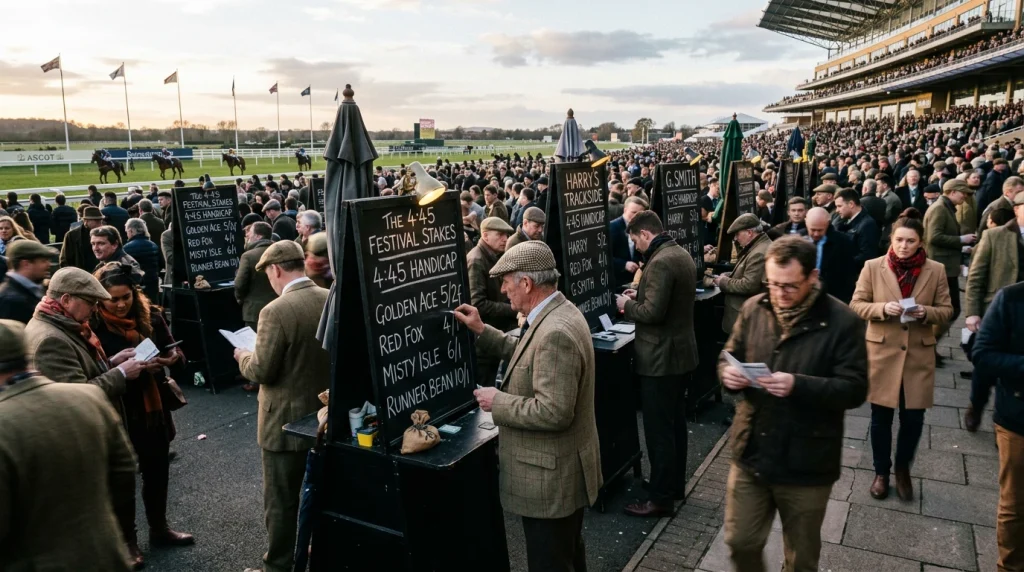
Maximising Payouts: Selecting SP or Fixed Early Prices on Large Bets
Spring 2024, a Class 2 handicap at Newbury. I had done the form and was about to put £2,500 win on a 9/2 shot when my finger slipped onto the SP toggle. The bet went on at starting price. The horse drifted as the market chased a different runner, and SP returned at 6/1. The horse won by a length. In my own bet diary it sits as a £400 loss, because Best Odds Guaranteed at 9/2 would have paid out at the SP of 6/1 anyway, and the 9/2 fixed price would have triggered the BOG promotion. By taking SP directly I forfeited the BOG uplift and walked away with exactly the SP return rather than the early-price return plus BOG enhancement.
The piece below is the working map of when SP is the right settlement choice, when early price is the right choice, and where the boundary actually sits for stakes large enough that the question matters. The answer is more interesting than the standard “always take the early price” advice from affiliate sites suggests, because the trade-offs change with market depth, the bookmaker’s BOG terms, and the size of the stake relative to the bookmaker’s pricing tolerance.
How industry SP is actually set
The starting price returned on UK horse racing is not a market-wide price discovered by exchange trading. It is set by a sampling panel of on-course bookmakers in the betting ring at the racecourse, plus on-course representatives of the major off-course books, who quote the horse during the final minutes before the off. The SP figure published is derived from the prices being quoted in the ring at the moment the stalls open, with a standardised formula that takes a weighted reading of the field and rounds to the nearest standard fractional price.
The on-course market is much smaller than the off-course market and the off-course exchange in matched volume, which means it can be moved by smaller amounts of money. Off-course bookmakers use the on-course ring as their reference point – they hedge the larger bets they have taken off-course back through the on-course books, which feeds money into the ring and influences the SP figure that will eventually settle their non-board bets. The structural consequence is that SP is a price set in the smaller market and used to settle bets struck primarily in the bigger market. Where the two markets diverge, the customer can be on either side of the gap.
SP has historically tended to be marginally shorter than the closing exchange price on most UK races, because the on-course ring carries a higher overround margin than the exchange does. The gap varies by meeting – Saturday handicaps with deep ring participation produce SPs much closer to closing exchange, midweek all-weather races with thin ring participation can produce SPs noticeably tighter than the closing exchange reference.
Early price and the board quote
Early prices are the fixed quotes a bookmaker puts up for a horse before the race goes off. They are typically published the night before for big Saturday cards and from late morning for weekday cards. Early prices reflect the bookmaker’s view of the horse’s chance plus a margin, and they shift through the day as money is taken on different runners and as the bookmaker’s exposure changes. The same horse might be 9/2 first show at one bookmaker, 5/1 at another, and 4/1 at a third – early prices vary across operators in a way SP does not, because SP is a single industry-wide figure.
The Best Odds Guaranteed promotion is what makes early price so interesting at scale. Most UK bookmakers honour BOG on horse racing, which means a punter who takes 9/2 early and watches the horse return at a longer SP gets paid out at the SP rather than the original 9/2. The combined position is therefore “9/2 if SP comes in shorter, SP if SP comes in longer” – a one-way structurally favourable position that the SP-direct customer does not have access to.
The BOG mechanism is why the standard professional advice has been to take early price wherever the early quote is at least equal to the prevailing market and to accept SP only where early prices are clearly worse than the SP is likely to be. The complication for large-stake punters is that BOG promotions come with caps, account restrictions, and conditions that change the practical attractiveness once stakes get beyond a certain level.
Where early price wins on a £2,000+ bet
The break-even logic on settlement choice at large stakes runs roughly as follows. Early price gives the customer the price displayed plus the BOG option on top. If SP comes in shorter, the customer gets the early price. If SP comes in longer, the customer gets the SP. The expected return from the BOG option, integrated across the typical distribution of price movement from early to SP, is meaningful – roughly 2% to 4% additional expected return on a portfolio of bets taken at well-judged early prices.
The customer-side cost of the early-price approach is that the early price you can actually take is sometimes lower than the morning showing, because the bookmaker has already moved the price by the time you click. The cost is also that early-price action is the pattern that flags accounts for stake factoring fastest – the trading team is watching which accounts consistently take morning prices and benefit from BOG uplifts, and those accounts get restricted within a season or two. The expected value of early-price taking is therefore positive for the customer but negative for their long-term ability to keep their account open at the same bookmaker.
For one-off large stakes from an account that is not yet flagged, early price is almost always the right choice. The 2% to 4% expected gain on a £5,000 bet is £100 to £200 of expected value, which is significant. For ongoing systematic betting at scale, the early-price approach generates restriction pressure that eventually closes the route – which is why the most operationally durable patterns I have seen blend early-price taking with selective SP betting on races where the early price is genuinely worse than the expected SP.
Where SP wins on a large bet
SP becomes the right choice when the early prices being offered are noticeably tighter than the prevailing exchange market, which typically happens in two situations. The first is on small fields where the bookmaker’s overround is being concentrated across few runners, producing tight individual prices that are unattractive compared to the broader market consensus. The second is on races where the bookmaker has known liability – the horse is being heavily backed and the bookmaker is shortening the early price aggressively to discourage further money.
In both situations, the closing exchange price is typically longer than the bookmaker’s early quote, and SP often returns near the closing exchange price rather than the bookmaker’s morning quote. Taking SP captures the longer expected return without the BOG option, but the absence of the BOG option matters less because the SP itself is likely to be longer than any early quote available.
The other situation where SP becomes operationally preferable for large stakes is when stake-factoring restrictions have made early prices unavailable at the required size. An account that is factored to 5% of the advertised maximum can put £100 on at the early price but cannot put £2,000 on. The same account can typically still bet £2,000 to SP at most bookmakers – SP bets are settled after the off, the bookmaker’s exposure is balanced by the time the bet is matched, and the operator’s risk team has less reason to factor the stake. For accounts that have been restricted, SP becomes the operational substitute for the inaccessible early prices.
The radio market and modern SP formation
The architecture of how SP is formed has evolved through the last decade as the on-course ring has shrunk. The number of betting shops in Britain has fallen for eleven consecutive years to 5,825 as of 2024-25, and the on-course ring has shrunk in parallel – fewer pitches at the racecourses, fewer firms operating, and a smaller pool of money flowing through the ring to set the SP price. The SP returned today is set by a smaller sample of bookmakers than would have produced the same figure ten years ago.
The decline of the ring has had two effects on SP. The first is that SP returns are more volatile race-by-race than they were historically – a single large on-course bet can move the SP figure substantially on a thinly-traded race. The second is that the gap between the closing exchange price and SP has widened in recent years on some classes of race, with SP frequently sitting tighter than the closing exchange figure on midweek small-field cards.
The practical implication for large-stake punters is that SP is no longer a reliable substitute for the closing exchange price. Punters who want exposure at the closing exchange price should ideally trade the closing exchange directly – taking a position into the closing minutes on the Betfair Exchange, which handled £84 billion in matched volume in 2025 – rather than relying on SP to deliver the closing market reading. The exchange close is now the more honest reference for the consensus price, and SP has become a settlement convention rather than a market-discovered price.
The hybrid approach used by serious punters
The most operationally durable settlement strategy I see across serious UK racing punters is neither pure-SP nor pure-early-price but a hybrid that selects between the two on a race-by-race basis. The selection logic runs roughly as follows. Take early price plus BOG when the early price is at least equal to the morning exchange consensus, the bookmaker BOG cap is high enough to cover your stake, and your account has not yet been flagged. Take SP when the early prices on offer are tighter than the exchange consensus, the field is small enough that the on-course ring will set SP close to exchange close, or your account has been factored to the point where early-price taking is operationally infeasible.
The hybrid pattern has a secondary advantage in account preservation. Splitting betting volume between early-price and SP routes spreads the visible pattern of the account across multiple bet types, which slows the trading team’s ability to identify the account as a systematic early-price taker.
The final consideration is that BOG generosity has been declining across UK operators through 2024 and 2025 as the duty rises ahead of 2026 and 2027 reduce operator margin. Several major bookmakers have introduced lower BOG caps or excluded specific race types. The underlying mechanics of the BOG promotion at large stakes are covered in the working map of BOG caps and how the promotion behaves on five-figure bets.
Why is industry SP often shorter than the closing exchange price on UK racing?
The on-course ring that sets SP runs a higher overround margin than the exchange, and the ring has shrunk over the last decade as betting shops have closed and pitches have consolidated. Less money flows through a smaller pool of bookmakers, which produces tighter quotes on average, and SP frequently sits shorter than the closing exchange price as a result – particularly on midweek small-field races where ring participation is thinnest.
Does taking early price always beat SP on a £2,000 win bet at a UK bookmaker?
No. Early price plus BOG is the structurally better choice when the early quote is at least equal to the prevailing market consensus, because BOG converts the early price into a one-way option that pays the longer of early price and SP. But early prices on small-field or heavily-backed races are often tighter than the eventual SP, in which case taking SP captures the longer return without paying for an unhelpful early quote. The right choice depends on the specific race and the early price actually available, not on a universal rule.
Articles
Written by the editors at High-Stakes Horse Racing Betting.
