
Going Stick Analytics and High-Stakes UK Handicap Betting
 Available in US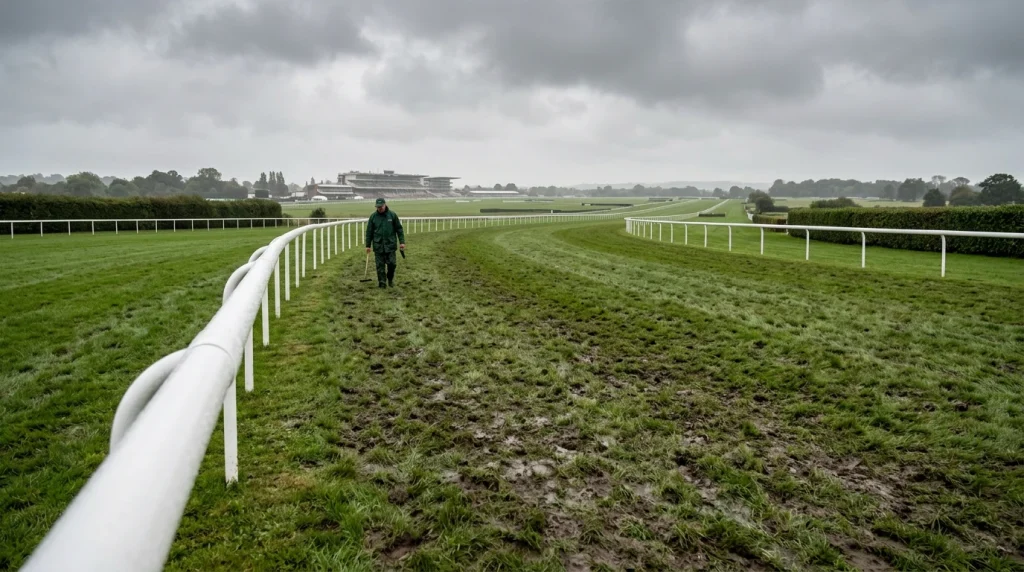
Track Condition Pricing Bias: Factoring Going Stick Readings into Sizing
I had a position on a six-runner Listed race at Newmarket priced up overnight. The horse needed good to firm ground to bring its closing kick into play. The forecast had been dry for three days straight. I went to bed comfortable with the stake. Overnight, an unbroken band of rain crossed East Anglia and dropped half an inch on the Rowley Mile by morning. The official going changed from good to good to soft. The horse drifted from 9/4 to 7/2 across the morning, ran disappointingly, and finished fifth. My read on the form had been correct. My read on the going had not been. The horse was a different animal once the ground turned, and the bookmaker’s overnight pricing had captured that shift far quicker than I had.
Ground conditions are the most important non-form variable in British racing, and they move prices in ways that punters routinely underestimate. On a flat handicap at Goodwood in July, the difference between good and good to firm is genuinely the difference between two different races run by the same fourteen horses. The horse that wins on good to firm finishes seventh on good. The horse that struggles on good to firm wins on good. At five-figure stake sizes the cost of reading ground wrong is large enough to dominate any other modelling decision.
This piece is the working guide. How the GoingStick measures what the eye cannot, where ground bias actually exists at British tracks, and how to size positions when the going changes between morning and post time.
What the GoingStick actually measures
The GoingStick is a penetrometer used by clerks of the course to produce a numerical reading of ground firmness. The instrument records two values at multiple points around the track. The first is shear strength, which measures how much the ground resists lateral movement. The second is penetration, which measures how far the device sinks into the surface under standard pressure. The combined reading produces a single numerical going figure, typically between 4 (heavy) and 13 (firm).
The numerical figure is the headline. The underlying detail matters more for serious punters. A track that reads 8.5 with high shear strength and low penetration is genuinely fast and produces fast times. A track that reads 8.5 with lower shear strength and higher penetration is officially the same going but plays differently underfoot, often producing slightly slower times and favouring different running styles. The official going description – good, good to firm, firm – corresponds to a numerical range rather than a specific number, which is why two days both described as good can produce very different race results.
Clerks of the course publish GoingStick readings on the morning of racing, with updates through the day if conditions change materially. The reading is the official record but it is averaged across the course. Some tracks have meaningful variation between the straight, the bend, and the home stretch. Reading the variation matters for serious analysis because horses with specific style preferences interact differently with different sections of the same track.
The published figure is the starting point, not the conclusion. I supplement it with track-side observation when possible, jockey post-race comments from the previous day’s racing, and the time of the opening race, which usually serves as a clean read on the ground because the runners are fresh and the surface is undisturbed. Across a typical British flat season, my own going adjustments to bookmaker prices account for roughly a third of the edge I find on individual handicaps.
Track-specific going biases that the market does not fully price
Some British tracks produce going biases consistently enough that the market does not fully adjust for them. Beverley’s stiff finishing hill on its right-handed sprint track favours horses that stay further than the trip suggests, particularly on softer ground. Brighton’s switchback course produces unusual results on any ground because the running line matters more than the official going. Chester’s tight track on any ground rewards horses drawn low in handicaps regardless of the going stick reading.
Lingfield’s Polytrack and Kempton’s Polytrack are different surfaces that respond differently to weather. Both are described as standard all-weather, but Lingfield rides faster on most days and Kempton rides truer. A horse that runs well on one is not automatically suited to the other. The bookmaker’s overnight pricing usually reflects the published going correctly but does not always reflect the surface-specific bias that experienced punters spot.
Goodwood’s downs course produces some of the most pronounced going biases in British flat racing. The cambered straight on Stewards Cup day plays very differently to soft ground than to firm. Horses drawn on the stands’ side rail benefit from the camber on most going. Horses drawn on the far side benefit from the rail running line on heavy ground. The bookmaker’s draw bias adjustments are usually generous on firm and conservative on soft, which produces consistent value opportunities on the far side of softer-ground sprint handicaps.
Newmarket’s two courses – the Rowley Mile and the July Course – also produce going-specific biases. The Rowley Mile rides faster than its official going suggests on cool, dry days because the wind across the heath dries the surface unevenly. The July Course rides truer to the going stick. Backing horses suited to genuinely fast ground on the Rowley Mile in cool weather has been a consistent edge across recent seasons regardless of what the published going says.
Sizing positions when the going changes overnight
The hardest stake-sizing decision in British flat racing is the overnight going shift. The going-stick reading at 4pm the day before racing is often noticeably different from the reading at 8am on race day. Overnight rain, dew, frost, sunshine and wind all change the surface in ways that the morning’s reading may not fully capture if conditions are still changing.
The conservative approach is to size positions based on the worst plausible going read on race-day morning. If the forecast suggests overnight rain could produce a shift from good to good to soft, the position is sized for good to soft conditions and the going stick reading is checked at 8am, 10am and 1pm on race day. If the reading confirms the morning assumption, the position holds. If conditions are firmer than expected, the position is increased before the off. If conditions are softer than expected, the position is reduced or hedged on the exchange.
The aggressive approach is to size positions based on the most likely going read and accept the risk of an adverse shift. This works only if the punter has good confidence in the forecast and the morning reading. For five-figure stakes the aggressive approach produces meaningful drawdown variance and is only suited to punters who have a positive expected value position large enough to compensate for the variance.
The pragmatic approach for most large-stake punters is to take a primary position the night before at advertised prices and a smaller adjusting position on race day morning once the going stick reading confirms or shifts the original assumption. Total turnover on UK racing fell 9% year on year in early 2025, with average turnover per fixture down 14.4% on core fixtures. The reduced volume makes overnight pricing more reactive to weather than it was three or four years ago. Bookmakers respond faster to going changes than they used to because the underlying liquidity is thinner and the risk of standing wrong prices is higher. Reading the overnight pattern is a more reliable edge than it used to be precisely because the prices move more meaningfully.
The professional punter’s going stick workflow
The practical workflow I use across a Saturday morning for a five-figure position runs like this. Day before racing, I check the going stick reading published at 4pm, the weather forecast through to morning, the wind direction (which affects how rain falls on cambered tracks), and the historical correlation between published going and actual race times at the specific track. Overnight, I monitor any actual rainfall versus forecast and adjust my assumed going for race day accordingly.
Race-day morning, I check the 8am going stick reading, cross-reference it with my overnight expectation, and compare it to historical going stick readings on similar weather patterns at the same track. If the reading is within 0.3 of my expected value, the position holds. If it diverges more than 0.3, I rerun the form analysis for the specific runners with the new going assumption and decide whether the original position is still positive expected value.
For races where the going makes a substantial difference – handicaps with horses that have run on multiple ground types and shown distinct preferences – the morning recalculation can flip a position from value to anti-value. The horse that was value at 8/1 on good ground might be a 14/1 layoff on heavy. The reverse also happens. A horse that looked moderate at 12/1 on the original assumed going might become value at 10/1 once the ground is heavier than expected.
The discipline that matters is not just the analysis. It is the willingness to walk away from a position once the going has shifted. Sunk-cost thinking is the biggest enemy of consistent ground-adjusted punting. The work done overnight is sunk. The bet is not yet placed. If the morning’s going makes the position negative expected value, the right action is to not place the bet, not to place a smaller version of the bet you had planned the night before. The same principle applies to the related question of when to take early prices versus SP on changeable ground. BOG on a horse whose price depends materially on going is a different decision from BOG on a horse whose price is stable regardless of conditions.
How much does a single going stick point change typical handicap prices?
A one-point shift on the going stick – for example from 8.5 to 7.5 – typically produces a 10-25% price movement on horses with strong going preferences. Horses that need fast ground will drift on softer readings, while horses that act on soft will shorten. Horses without strong preferences see smaller adjustments, often less than 5%.
Which UK tracks have the most pronounced ground bias on big handicap days?
Goodwood"s downs course on Stewards Cup day, Chester"s tight track across the May meeting, and Brighton"s switchback course are among the tracks with the most pronounced ground-specific biases. Each produces results that diverge from the form book in predictable ways depending on the going stick reading and the draw.
Articles
Published by the High-Stakes Horse Racing Betting team.
