
The 2000 Guineas at Newmarket: How Big Bettors Approach the Classic Weekend
 Available in US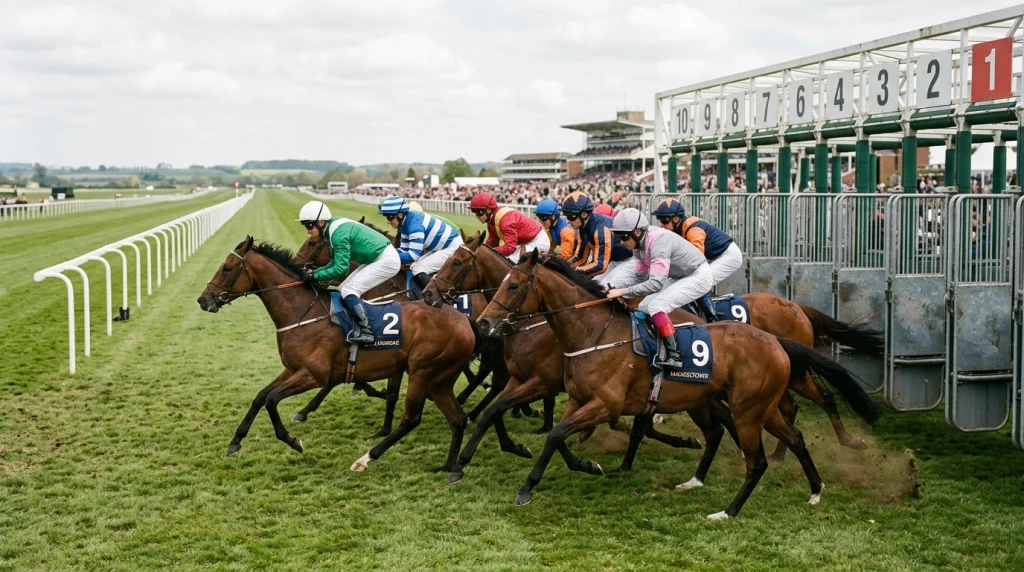
The first weekend in May that resets the Flat season
The first weekend in May at Newmarket is when my Flat betting year actually starts. The Craven meeting in mid-April is a trial. The Lincoln is a handicap puzzle that tells you nothing about the Classics. But the 2000 Guineas weekend – the 2000 on Saturday, the 1000 on Sunday – is when the three-year-old generation declares itself in front of markets that have been pricing these horses since November of their juvenile season. For a large-stakes punter, this is one of the four or five weekends each year where liquidity, narrative pressure, and genuine information asymmetry create real opportunity.
The Rowley Mile is the only racecourse in Britain where the Classic distance is run on a true straight mile. No bends, no hidden lanes, no traffic caused by a curve. What you see is what is happening. That makes the race a pure test of milers in a way that the Curragh’s 2000 Guineas or the French equivalent at Longchamp cannot match. It also means betting markets are unusually clean. The favourite who runs flat runs flat for visible reasons. The 25/1 shot who runs to within two lengths of the winner was almost certainly underrated rather than getting away with a soft trip.
This piece is how I approach the weekend from a staking perspective. Ante-post timing, the in-running spots on the Rowley Mile, the systematic biases of the Guineas as a betting heat, and the wider weekend turnover picture that tells you when liquidity will be deepest.
What Guineas weekend means for turnover
The 2000 Guineas is not the biggest Saturday in the British racing calendar. That title belongs to Grand National day, where 2025 saw around £250m bet across the day with ITV’s terrestrial peak of 5.2m and roughly 600m viewers worldwide. The Guineas pulls a fraction of that. Where the weekend matters is in being the first Saturday of the year where genuine Flat-racing money – syndicates, pattern-race specialists, breeding-led punters – engages at full size.
The numbers tell the story. UK racing 2025 set a record £194.7m in prize money. Total attendance hit 5.031m, with under-18s up 17% to 211,447 – the leading indicator that the sport’s audience is regenerating. The Guineas weekend is the moment that audience returns to Flat racing after a winter dominated by Cheltenham, the Grand National, and the spring handicaps. For a large-stakes punter, the practical consequence is that exchange liquidity on the Saturday afternoon will be three to four times what you saw a fortnight earlier at the Craven meeting, and bookmaker stake tolerance will be markedly higher because the volume cover is there.
The contrast with weak weekends is sharp. UK racing turnover was down 9% year-on-year in early 2025, and HBLB-tracked average turnover per race was down 8% YoY, 15% versus 2022-23, and 19% versus 2021-22. Inside that picture, Premier Fixture turnover was up 2.7% while core fixture turnover was down 8.6%. Guineas weekend is a Premier Fixture – one of the days where money still flows.
Ante-post: the timing problem
Most of my Guineas weekend ante-post action is placed between mid-March and early April, in the three to four weeks before the Craven meeting clarifies the picture. By February the market is dominated by horses priced on two-year-old form plus a handful of unraced winter-trained colts being talked up by yards with reasons to do the talking. By the start of May the market has compressed around three or four horses and the value has gone.
The window I care about is the period when the leading two-year-old miler of the previous autumn is priced around 5/1 to 8/1, before he has run a Classic trial. Once he runs the Greenham or the Craven, the price either collapses to 7/2 or drifts to 14/1, and the value position has resolved either way. The bet I am willing to size up is the one I make before that resolution, with a clear view on the horse’s mile credentials and a market that has not yet priced them in.
Hedging is the other half of the equation. If I have backed a horse at 8/1 ante-post and he is now 5/2 on the morning of the race, the question is whether to lay back. The answer depends on the depth of the market and the stake size. On a £5,000 outlay at 8/1, the £40,000 potential return is large enough that some hedge makes sense – I would typically lay back enough to lock in a guaranteed mid-four-figure profit while leaving a six-figure upside if the horse wins. The mechanics overlap heavily with what I have written on hedging ante-post positions across a season of UK racing, which goes into the specific calculations.
The Rowley Mile as an in-running race
Three years ago I watched the 2000 Guineas with a £4,000 lay position on the favourite at 3.2 in the in-running market. The horse was tracking the leaders, travelling smoothly, and at the two-furlong pole I was looking at being right by every visible measure. Then he quickened. The price collapsed from 3.2 to 1.4 in eight seconds. I had a stop on the position but the stop did not trigger because the price went through it too fast for the matching engine to find me a counterparty at any reasonable level. I got out 60% worse than I had planned.
That experience taught me the central fact about in-running on the Rowley Mile. Because the course is a straight mile with no traffic and no kink, the strongest horse usually wins, and the strongest horse usually announces itself with a quickening burst inside the last two furlongs that the in-running market reads instantly. The window between “still competitive” and “going to win” is sometimes six or seven seconds. If you are laying a horse who has just quickened, you are not getting matched at the price you see – you are getting matched at whatever the next quote is, which might be 50% lower.
What works on the Rowley Mile in-running is backing horses who are travelling on the bridle with a furlong and a half to run, against horses who are already being scrubbed along. The price differentials in those moments are often wider than the actual remaining race justifies, because the market reacts to body language with a lag. The bet to avoid is the lay of the favourite who is still cantering – that bet has cost large-stakes punters more money on the Rowley Mile than any other single tactic I can think of.
The bias question: front-runners, draw, going
There is a persistent myth that the 2000 Guineas favours a horse drawn high – on the stands’ side rail – when the ground is fast. The actual evidence is messier. Across the last fifteen runnings the winning draw has been distributed roughly evenly across the field, with a slight bias towards horses drawn in the middle when the ground was good to firm and a very mild stands’-side bias when the ground was good to soft. The bias punters who talk about it as if it were a 65/35 advantage are reading noise.
What does matter is going. Soft ground reshuffles the Guineas in ways that the price seldom catches. A horse priced 12/1 who is proven on soft and a horse priced 3/1 who has only ever run on good – by the time the ground changes overnight and the market has had six hours to adjust, the prices have moved, but they have not moved enough. I make some of my biggest plays on the Guineas weekend in exactly that scenario: morning of the race, overnight rain, going changed from good to soft, market still discounting the change.
Front-running is the third bias to weigh. The 2000 Guineas is not won from the front as often as people assume. The Rowley Mile climb in the final two furlongs is severe enough that a true front-runner who has gone hard from the gates will be passed by something travelling better at the furlong pole. Hold-up horses with proven acceleration win it more often than the casual punter expects. This affects the in-running market – the front-runner who looks comfortable two out is usually about to be caught, and the in-running price that has him at 2.0 is offering value as a lay if you can get matched.
Sizing the Saturday card around the Guineas
The Saturday Guineas card has seven races. The 2000 Guineas itself is race four. I treat the day as a single staking unit with a budget I set the night before, and the budget is heavily weighted towards the Guineas itself – typically 50% of the day’s outlay in the Classic, with the remainder spread across two or three other races where I have specific views. The supporting races on the card are competitive in their own right, but price discovery on them is far less efficient than on the Guineas, which is precisely why the side bets sometimes carry the day even when the Classic itself doesn’t deliver.
Stake limits become a real factor on a card like this. The bookmakers who will take a £20,000 Guineas bet at 6/1 in the morning often quietly factor the account to a £200 limit by the time you try to back a 12/1 shot in the next race. Betfair Exchange traded around £84bn of bets in 2025, up roughly 10% year-on-year, with horse racing the dominant share. On Guineas Saturday the Classic win market supports clean five-figure matches without slippage, which is why a serious punter has to be on the exchange. The 5% premium charge is the real cost – Smarkets and Matchbook at 2% commission are cheaper, but their Guineas-day liquidity is a fraction of Betfair’s.
What I have learned about the Sunday after
The 1000 Guineas on Sunday is the smaller of the weekend’s two Classics in betting terms but not in pricing efficiency. The fillies’ market is consistently the harder of the two to beat, partly because the form lines from juvenile fillies’ races are unusually clean – fewer maiden races, more black-type pattern races, and stronger correlation between two-year-old and three-year-old performance than in the colts. The fillies who win at two tend to win at three. The market knows this, and the prices reflect it.
The contrarian view that pays on Sunday is the lightly raced filly from one of the three or four yards who consistently produce Classic-winning fillies from spring debuts. Price usually 12/1 to 20/1, strike rate low – perhaps one win in eight – but the implied odds in the long run sit well above the prices on offer. I size those bets at half the Saturday Guineas position because variance is higher.
The weekend ends with bankrolls flush or bruised, and the lessons compound. Guineas weekend is the first real exam of the Flat season’s discipline. Over-stake, panic on a 4/1 favourite that drifts, or chase losses into Sunday, and the rest of May will punish you. Carry sensible sizes, place ante-post in the right window, and read the in-running market with appropriate skepticism, and you walk out of Newmarket with a position that funds the next four months of patient Flat-race punting. That is what the weekend is for.
When is the best time to place ante-post bets on the 2000 Guineas?
The window I find most productive is mid-March to early April, before the Craven meeting in mid-April clarifies the picture. By that point the leading colts have been priced on their two-year-old form but have not yet run a Classic trial. Once the Greenham and Craven are run, the market either compresses to a clear favourite at 7/2 or drifts the previous market leader to 14/1, and the value opportunity has resolved. After the first weekend of May the prices reflect everything the market knows.
How big is the in-running market on the Rowley Mile?
The win market on the 2000 Guineas itself supports clean five-figure matches at the top of the book without significant slippage on Betfair Exchange. Where you have to be careful is the speed of price collapse – a horse who quickens in the final two furlongs can see his in-running price drop from 3.2 to 1.4 in under ten seconds, faster than most stop-loss orders can be filled. Lay positions need to be placed with an understanding that you will not get matched at the price displayed if the horse is in the act of winning.
Does the draw matter in the 2000 Guineas?
Less than punters often think. Across the last fifteen runnings the winning draw has been distributed roughly evenly across the field. There is a mild middle-draw bias on good to firm ground and a very mild stands" side bias on softer ground, but neither effect is strong enough to override form. Going matters far more than draw – soft ground overnight regularly reshuffles the market in ways the prices fail to fully capture by post time.
Articles
Written by the editors at High-Stakes Horse Racing Betting.
